Total Knee Replacement: To Use Cement or Not
Dr. Patrick D. Brooks
11/2/2026
Cemented vs. Cementless Knee Replacement: What's the Difference?
Understanding How Knee Replacement Implants Are Secured to Bone
When patients think about a total knee replacement, they often focus on the artificial joint itself. However, one of the important decisions during knee replacement surgery is how the new implant is secured to the bone.
Traditionally, most knee replacements have been performed using bone cement to hold the implants in place. Cement acts like a grout to adhere the metal to the bone. More recently, advances in implant design and materials have increased interest in cementless knee replacement. These implants have porous coating on the surface that allows the bone to grow into them over time.
Both techniques can provide excellent results, but there are important differences worth understanding.
What Is Bone Cement in Knee Replacement?
During a total knee replacement, damaged cartilage and a small amount of underlying bone are removed from the ends of the femur (thighbone) and tibia (shinbone). These surfaces are then replaced with artificial components, typically made of metal and durable plastic.
One of the most common ways to secure these implants is with bone cement, also known as polymethylmethacrylate (PMMA).
Despite its name, bone cement does not work like glue. Instead, it fills small spaces and irregularities between the implant and the prepared bone, creating a strong mechanical connection.
The cement hardens within about 10-15 minutes, providing immediate fixation of the implant.
Bone cement has been used successfully in knee replacement surgery for decades and remains a reliable method of implant fixation.
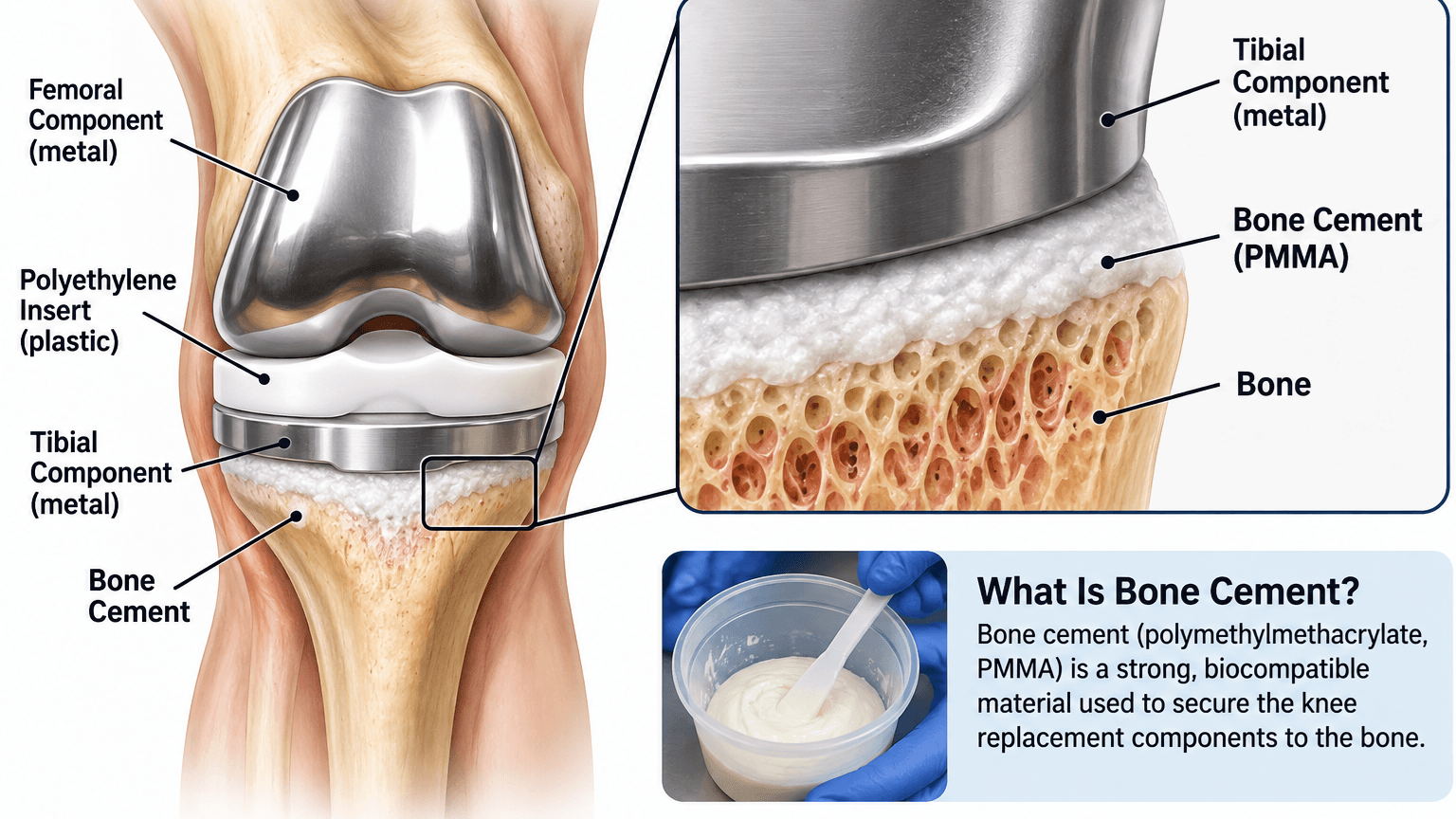&srotate=0)
Cement Use in Knee Replacement
What Is a Cementless Knee Replacement?
A cementless knee replacement uses a different method to secure the implant.
Rather than relying on bone cement, cementless implants are designed with specialized porous surfaces that allow the patient's own bone to grow onto or into the implant.
Initially, the implant is held securely through a precise fit against the prepared bone. Over time, bone growth into the porous surface creates a biological connection between the implant and the patient's skeleton.
This process is called osseointegration.
Modern cementless implants have benefited from improvements in porous metal coatings, implant geometry, and manufacturing technology.
These advances have made cementless fixation an increasingly attractive option for certain patients.
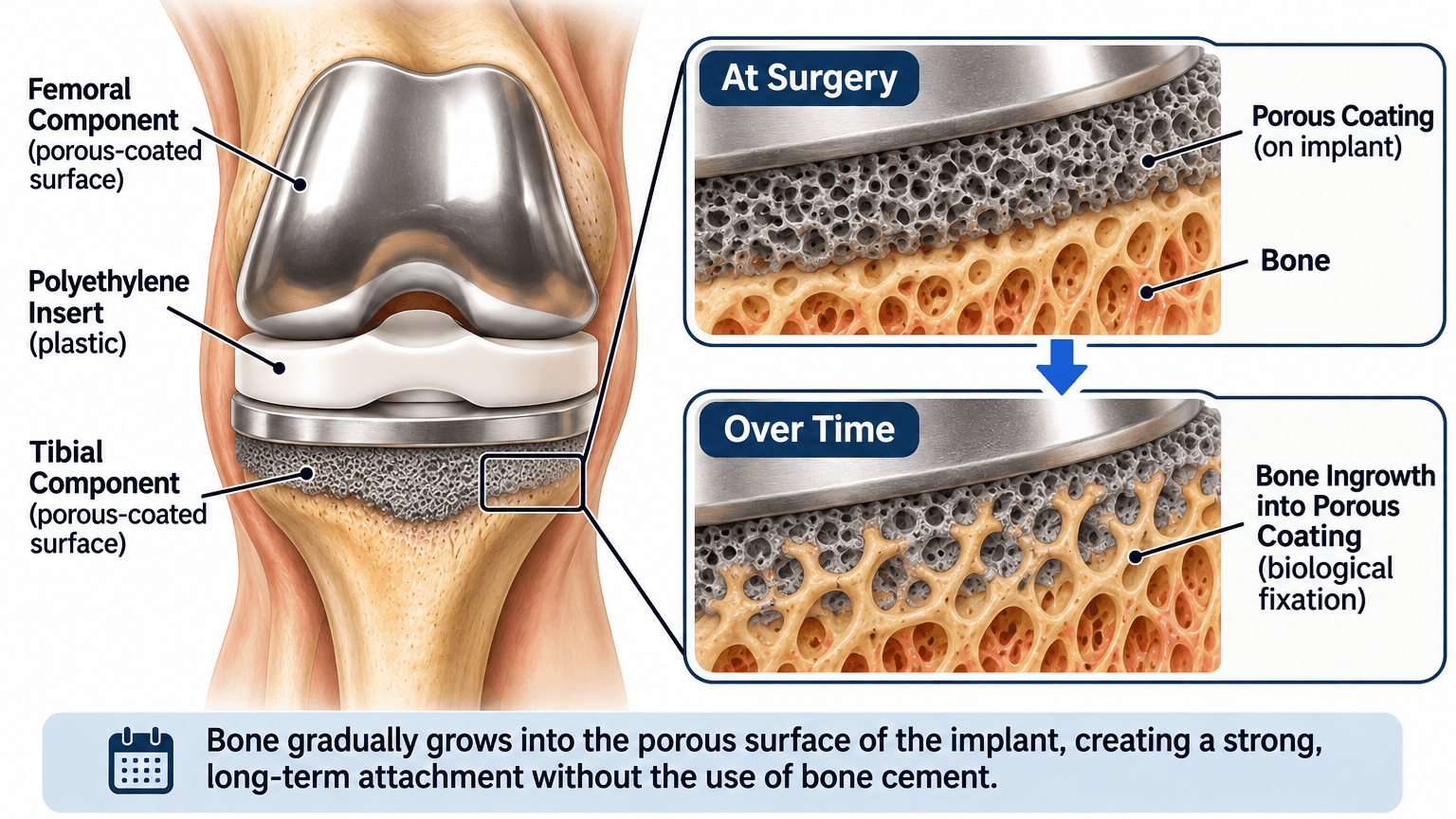&srotate=0)
Bone Ingrowth on Cementless Implants
What Are the Advantages of Cemented Knee Replacement?
Cemented knee replacement has a long history of successful outcomes and remains the most extensively studied fixation method in total knee arthroplasty.
Potential advantages include:
Immediate fixation: The implant is secured as soon as the cement hardens.
Excellent long-term results: Cemented implants have demonstrated durability over decades of clinical use.
Reliable fixation in different bone types: Cement can be particularly useful in patients with reduced bone quality.
Versatility: Cemented fixation can accommodate a wide variety of implant designs and patient anatomies.
For many patients, cemented knee replacement remains an excellent choice.
What Are the Advantages of Cementless Knee Replacement?
Cementless knee replacement has gained popularity, particularly among younger and more active patients.
Potential advantages include:
Biological fixation: Bone can grow into the implant surface, creating long-term fixation.
Avoidance of the cement interface: This eliminates one potential location where mechanical loosening can occur.
Potential long-term durability: Biological fixation may offer benefits in patients expected to place many years of demand on their implants.
No cement preparation or curing: This eliminates the cementing portion of the procedure and saves on 10-15 minutes of time.
Although these benefits are promising, cementless fixation is not necessarily superior for every patient.
Successful cementless fixation depends on achieving excellent initial implant stability and having sufficient bone quality to support bone ingrowth.
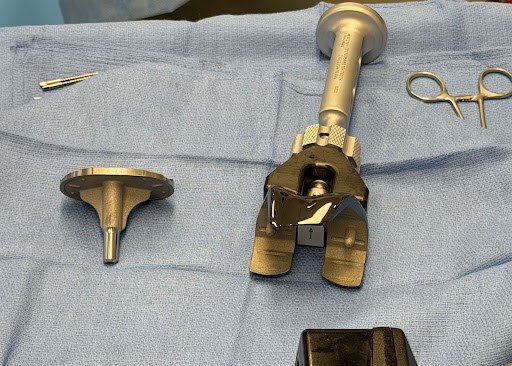&srotate=0)
Cemented knee implants are smooth on their inner surfaces
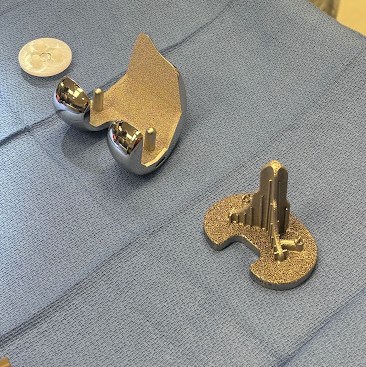&srotate=0)
Cementless implants have porous, rough coating to allow bone to grow into over time
Is Cementless Knee Replacement Better Than Cemented Knee Replacement?
This is one of the most common questions patients ask.
The short answer is that both techniques can provide excellent pain relief, improved function, and long-lasting results. Right now studies do not show one is better than the other.
Cemented knee replacements have decades of successful clinical data supporting their use. Modern cementless knee replacements have also demonstrated encouraging outcomes, with some studies showing results comparable to cemented implants in appropriately selected patients.
However, cementless fixation has not been consistently shown to produce better long-term outcomes for all patients.
Additionally, the long-term performance of newer cementless implant designs continues to be evaluated.
The most important factor is selecting a fixation method that provides stable, durable implant fixation for the individual patient.
How Do Surgeons Decide Between Cemented and Cementless Implants?
Several factors influence the decision, including:
1. Patient Age and Activity Level
Younger, more active patients may be considered for cementless fixation because of the potential benefits of biological fixation over many years.
2. Bone Quality
Patients with strong, healthy bone may be good candidates for cementless fixation. Patients with poor bone quality or significant osteoporosis may benefit from cemented fixation.
Does Cemented or Cementless Fixation Affect Recovery?
No. It does not. In fact some studies may show that cementless fixation may have higher pain experiences for only the first few weeks.
Both cemented and cementless knee replacement patients can typically begin walking and participating in physical therapy shortly after surgery.
Regardless of fixation method, recovery focuses on controlling pain and swelling, restoring knee motion, strengthening the surrounding muscles, and gradually returning to normal activities.
The fixation method alone usually does not determine how quickly a patient recovers.
How Long Does a Knee Replacement Last?
Modern knee replacements are designed to provide many years of pain relief and improved function.
Large studies of knee replacement outcomes have demonstrated that many implants continue functioning well for 20 years or longer.
However, implant longevity depends on several factors, including implant positioning, fixation, patient activity, bone quality, infection risk, and implant design.
Both cemented and cementless knee replacements can provide excellent long-term durability.
The Bottom Line
There is no single fixation method that is best for every knee replacement patient.
Cemented knee replacement remains a highly reliable option with an extensive history of successful outcomes. Cementless knee replacement is an exciting advancement that offers the potential for biological fixation, particularly in appropriately selected patients.
Ultimately, the goal is not simply to choose between cemented and cementless fixation, but to provide a stable, well-functioning knee replacement that allows patients to return to the activities they enjoy.
Considering Knee Replacement Surgery?
If you are experiencing persistent knee pain from arthritis and nonsurgical treatments are no longer providing adequate relief, knee replacement may be an option.
A consultation with an orthopedic surgeon specializing in hip and knee replacement can help determine which treatment and implant options are most appropriate for your individual needs.
Learn more about knee replacement surgery and treatment options at patrickbrooksmd.com.
Recent Posts
Total Knee Replacement: To Use Cement or Not
This blog focuses on the options and indications regarding cement use in a knee replacement
Activities After Total Hip or Knee Replacement: What can I expect?
This blog focuses on what activities patients can expect to get back to after total hip or total knee replacement
Direct Anterior Hip Replacement: What is it?
Discussion on the direct anterior approach for total hip replacement including what it is and why it is becoming so popular