Activities After Total Hip or Knee Replacement: What can I expect?
Dr. Patrick D. Brooks
10/27/2026
One of the most common questions patients ask before hip or knee replacement is:
“What will I be able to do after surgery?”
For most patients, the goal of joint replacement is not simply to reduce pain—it is to help them return to the activities they enjoy. Modern hip and knee replacements are designed to allow patients to remain active, and many people return to exercise, travel, golf, cycling, swimming, and other recreational activities after recovery.
While every patient is different, here is a general guide to activity after hip or knee replacement.
The First Few Weeks: Focus on Walking and Recovery
Walking is one of the most important activities after joint replacement.
Most patients begin standing and walking shortly after surgery, typically on the same day. Initially, a walker or cane is necessary for safety and balance for the first week or two. As strength, confidence, and walking mechanics improve, patients can gradually transition away from assistive devices.
During the early recovery period, the priorities are:
- Walking regularly
- Gradually increasing distance
- Working on strength and mobility
- Performing prescribed physical therapy exercises
- Avoiding falls
- Allowing the incision and soft tissues to heal
Recovery is not a competition. Some patients progress very quickly, while others require more time.
&srotate=0)
Early Recovery
&srotate=0)
Increasing Walking Distance in First Few Weeks
Low-Impact Exercise
Once adequate healing has occurred, low-impact exercise is generally an excellent way to remain active after hip or knee replacement.
Common activities include:
Walking and hiking: Walking is one of the best long-term exercises following joint replacement. Patients can gradually progress from short neighborhood walks to longer distances and, when appropriate, hiking.
Stationary and outdoor cycling: Cycling provides cardiovascular exercise while placing relatively low impact on the hip and knee. A stationary bike is also frequently incorporated into rehabilitation.
Swimming: Once the incision has completely healed and the surgeon has cleared the patient to enter a pool, swimming and water exercise can be excellent options.
Elliptical training: The elliptical can provide cardiovascular exercise without the repetitive impact associated with running.
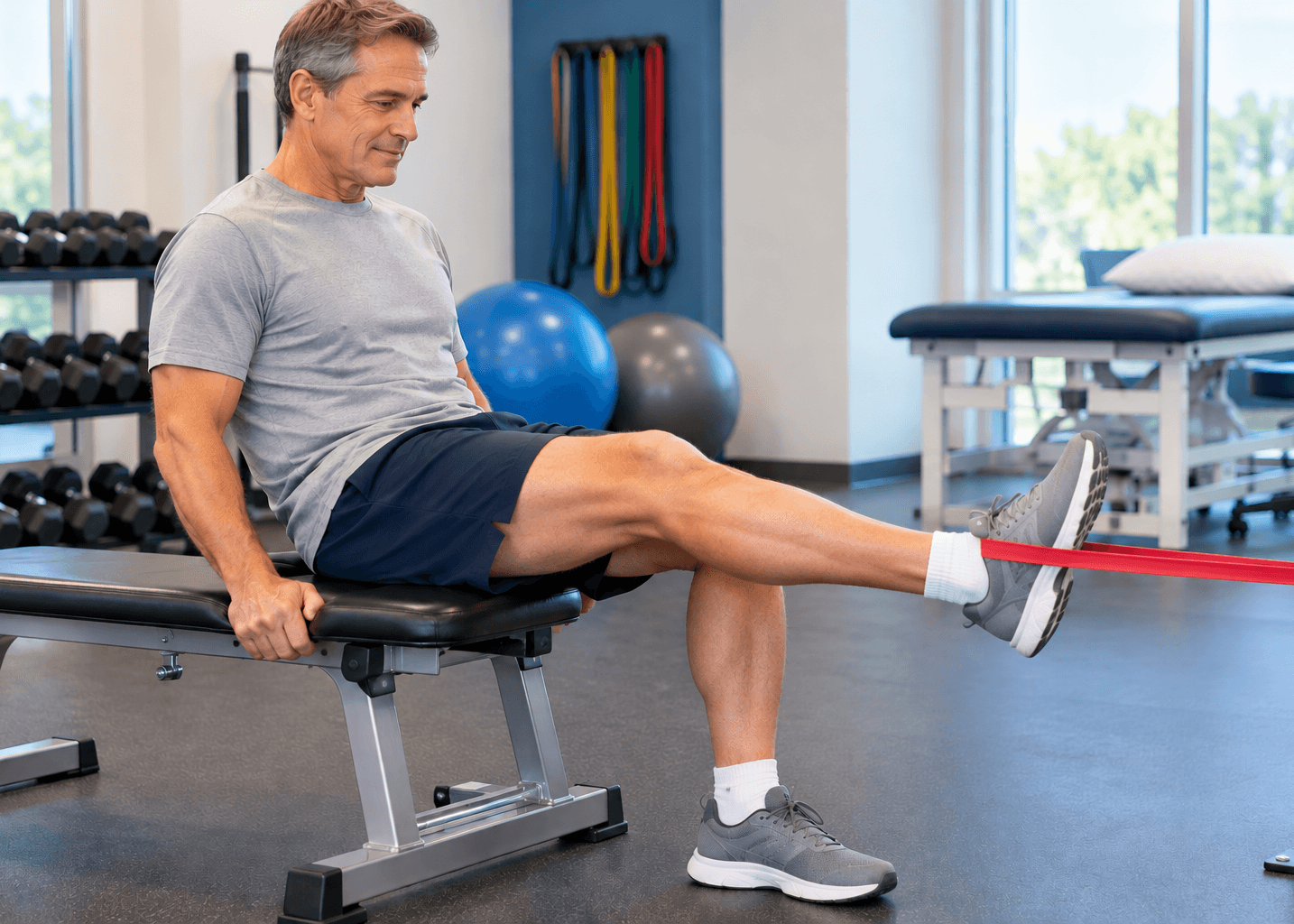
Strength training: Maintaining strong muscles around the hip and knee is important for long-term function. Patients can typically return to progressive resistance training, although technique and the amount of weight should be increased gradually.
&srotate=0)
Biking and Swimming Are Excellent Activities after Hip/Knee Replacement
&srotate=0)
Strength Training after joint replacement is very safe and encouraged
Can You Golf After Hip or Knee Replacement?
For most patients, the answer almost always is yes.
Golf is a common goal following both hip and knee replacement. Patients typically begin with putting and chipping before progressing to the driving range and eventually a full round.
The timing depends on the operation, strength, balance, and overall recovery. Patients should receive clearance from their surgeon before returning to a full golf swing. On average this begins about 3 months after surgery.
&srotate=0)
Golf after joint replacement is generally well tolerated
What About Pickleball and Tennis?
In general the answer is: Yes. Recreational doubles tennis and pickleball are reasonable for many patients once they have regained adequate strength, balance, and coordination.
These sports involve more rapid changes in direction than walking, cycling, or swimming, so returning gradually is important.
A patient's previous experience also matters. Returning to an activity that someone performed regularly before surgery can be different from beginning a new high-demand sport after joint replacement.
&srotate=0)
Pickleball is safe and well tolerated after joint replacement for most patients
Can You Ski After Joint Replacement?
Some experienced skiers return to recreational skiing following hip or knee replacement.
However, skiing introduces an important consideration: fall and injury risk. A significant fall can cause a fracture around a hip or knee replacement or damage the joint.
Patients interested in returning to skiing should discuss their individual situation with their surgeon and should generally return only after strength, balance, and coordination have recovered.
Can You Run After Hip or Knee Replacement?
Running is more controversial.
Shorter distances of running are usually tolerated by some patients, but repetitive long-distance running places substantially greater impact across a hip or knee replacement than activities such as cycling, swimming, or walking.
We still do not have perfect data defining exactly how repetitive high-impact activity affects modern implants over several decades.
For that reason, I generally encourage patients who want cardiovascular exercise to prioritize lower-impact activities when possible.
Will Being Active Wear Out My Replacement?
This is an understandable concern.
Modern hip and knee replacement implants have excellent durability, and remaining physically active has many important benefits for cardiovascular health, muscle strength, balance, weight management, and overall well-being.
At the same time, artificial joints are mechanical devices. Higher-impact and repetitive loading creates different stresses than lower-impact activities.
The goal is not to become sedentary to “protect” the replacement. Instead, the goal is to find a sustainable balance that allows patients to remain active while being thoughtful about unnecessary repetitive impact and injury risk.
The Goal: Get Back to Living
Hip and knee replacement should not be viewed as the end of an active lifestyle.
For many patients, it is exactly the opposite.
As arthritic pain improves and strength returns, patients will be able to return to activities that became difficult or impossible before surgery—from walking the neighborhood and playing with grandchildren to golfing, cycling, swimming, traveling, and exercising regularly.
Every patient's recovery is different, and return-to-activity recommendations should be individualized with your surgeon.
The ultimate goal of joint replacement is not simply to replace an arthritic joint—it is to help you get back to doing the things that make life enjoyable.
If you are in the Jacksonville area and considering a joint replacement and have questions about what activities to get back to, it may be worth meeting with a specialist to review your individual goals.
Recent Posts
Total Knee Replacement: To Use Cement or Not
This blog focuses on the options and indications regarding cement use in a knee replacement
Activities After Total Hip or Knee Replacement: What can I expect?
This blog focuses on what activities patients can expect to get back to after total hip or total knee replacement
Direct Anterior Hip Replacement: What is it?
Discussion on the direct anterior approach for total hip replacement including what it is and why it is becoming so popular