Robotics in Total Knee Replacement: How Does it Work?
Dr. Patrick D. Brooks
11/5/2026
Robotic-Assisted Total Knee Replacement: How Does It Work?
Understanding how robotic technology helps surgeons improve precision and personalize knee replacement surgery
Technology continues to advance in orthopedic surgery, and one of the most exciting developments is the use of robotic assistance during total knee replacement.
For patients suffering from severe knee arthritis, total knee replacement can provide significant pain relief and improve mobility and quality of life. Robotic technology offers surgeons additional tools to plan and execute the procedure with a high degree of precision.
A common question is: “Does the robot actually perform the knee replacement?”
The answer is no. The surgeon remains in complete control throughout the procedure. The robotic system is a sophisticated tool that helps the surgeon understand the patient's anatomy, plan implant placement, and perform precise bone preparation.
Let's walk through how robotic technology is used during knee replacement surgery.
Step 1: Creating a Digital Map of the Knee
Every patient's knee is different. The shape of the bones, degree of arthritis, alignment of the leg, and tension of the surrounding ligaments all influence how a knee replacement should be performed.
During robotic-assisted knee replacement, the surgeon creates or uses a detailed three-dimensional model of the patient's knee.
Depending on the robotic system, this may involve a preoperative CT scan or mapping the knee directly during surgery using specialized instruments.
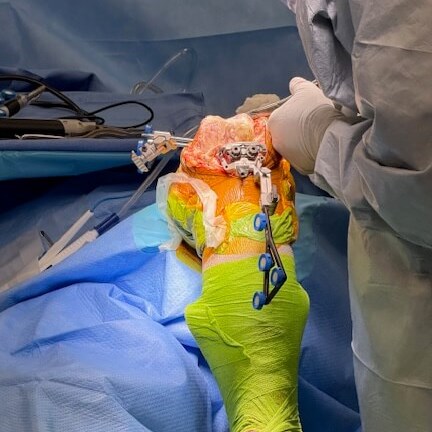
Small tracking devices attached to the femur (thigh bone) and tibia (shin bone) allow the computer to monitor the position of the bones throughout the procedure.
The system uses this information to help the surgeon understand the patient's unique anatomy and develop a personalized surgical plan.
&srotate=0)
Intra-operative photo showing the trackers in place which are attached to the patients shin and thigh bone
&srotate=0)
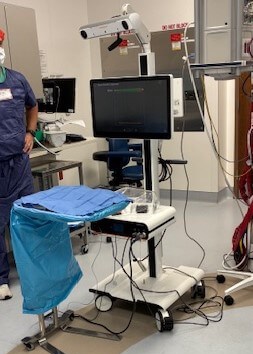
Robot Sensor and Set Up
Step 2: Evaluating Knee Alignment and Ligament Balance
One of the most important aspects of a successful knee replacement is achieving a knee that is both properly aligned and stable.
The knee contains several important ligaments that help control its movement. If these ligaments are too tight or too loose after knee replacement, patients may experience stiffness, instability, or discomfort.
With robotic technology, the surgeon can evaluate the knee throughout its range of motion and measure the spaces between the femur and tibia.
This provides valuable information about how the ligaments behave when the knee is straight and when it is bent.
Why is this important?
Rather than relying solely on visual assessment and manual instruments, the surgeon can use objective measurements to help determine the optimal position of the implants.
The goal is to create a knee that moves smoothly, feels stable, and maintains appropriate ligament tension.
Step 3: Planning the Position of the Knee Replacement
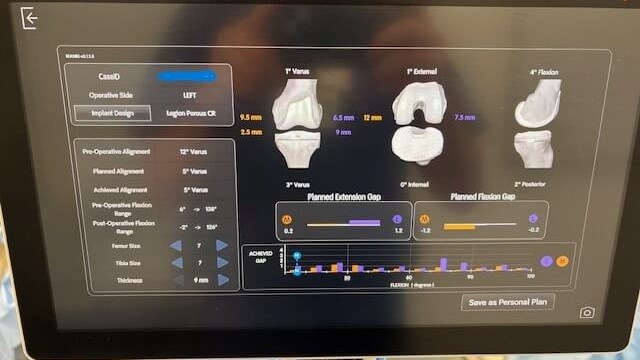
Before making the bone cuts, the surgeon can virtually position the knee replacement components on the computer screen.
This allows the surgeon to make adjustments to several important factors, including:
- The size of the femoral and tibial implants.
- The alignment and rotation of the components.
- The amount of bone that needs to be removed.
- The anticipated ligament balance and joint spacing.
- The overall alignment of the leg.
Small adjustments to implant position can make meaningful differences in how the knee is balanced.
One of the greatest advantages of robotic technology is the ability to evaluate these adjustments before making permanent cuts to the bone.
This provides an opportunity to personalize the surgical plan to each patient's anatomy rather than relying on exactly the same measurements for every patient.
&srotate=0)
This screen shows the position of the implants, alignment, and tension on the ligaments throughout the range of motion
Step 4: Performing Precise Bone Cuts With Robotic Assistance
Once the surgical plan has been finalized, the surgeon begins preparing the bone for the implants.
In traditional knee replacement, surgeons use specialized cutting guides and instruments to remove the damaged cartilage and a small amount of underlying bone.
With robotic-assisted surgery, the computer helps guide this process according to the surgical plan.
Depending on the robotic system, a robotic arm may guide the cutting instrument, limit its movement within predefined boundaries, or position a cutting guide with a high degree of accuracy.
This allows the surgeon to execute the planned bone cuts with greater precision.
Importantly, the surgeon remains responsible for performing and supervising the procedure. The robotic technology assists with the surgery rather than replacing the surgeon's judgment and expertise.
&srotate=0)
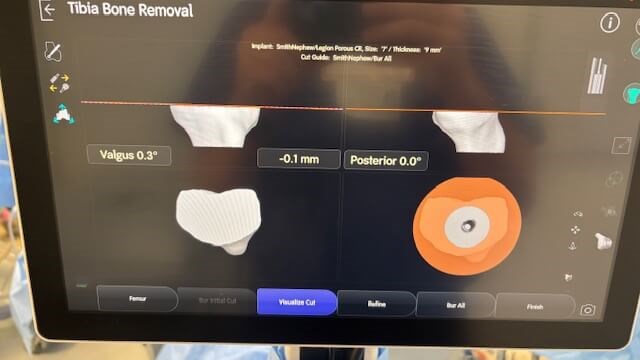
Evaluating the bony cuts
&srotate=0)
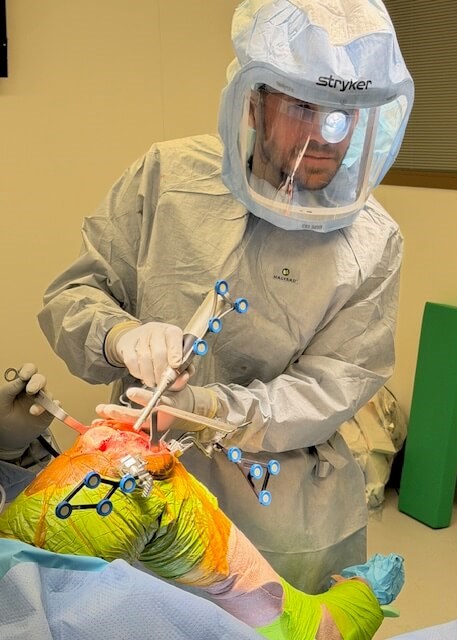
Using the Robotic Burr for Removing Bone
Step 5: Checking the Knee Before Placing the Final Implants
After the bone has been prepared, trial knee replacement components are placed.
The surgeon then evaluates the knee's movement, stability, and alignment.
Robotic technology can provide additional information about how the knee behaves through its range of motion, helping the surgeon determine whether adjustments are needed.
Once the surgeon is satisfied with the knee's stability and function, the final implants are placed.
The goal is to create a knee replacement that is well-positioned, stable, and capable of providing years of improved function.
What Are the Potential Benefits of Robotic Knee Replacement?
Robotic-assisted knee replacement offers several potential advantages compared with traditional surgical techniques.
1. Greater precision: Robotic systems can help surgeons execute bone cuts and implant positioning more accurately.
2. Personalized surgical planning: The procedure can be adjusted to each patient's anatomy, alignment, and ligament characteristics
3. Improved assessment of ligament balance: Real-time measurements can help surgeons evaluate knee stability and make adjustments during surgery.
4. More controlled bone preparation: Certain robotic systems help surgeons remain within predefined cutting boundaries.
5. Potential improvements in recovery: Some studies suggest improvements in early pain or function, although these benefits have not been consistently demonstrated.
While robotics can improve the technical accuracy of surgery, research has not consistently demonstrated that robotic knee replacement provides better long-term pain relief, function, or implant longevity compared with well-performed conventional knee replacement.
Is Robotic Knee Replacement Right for Everyone?
Robotic assistance can be beneficial for many patients undergoing total knee replacement, particularly when the surgeon wants additional information about alignment, anatomy, and ligament balance.
However, not every patient requires robotic technology to achieve an excellent result.
The most important factors remain careful surgical planning, proper implant positioning, appropriate ligament balance, and the experience of the orthopedic surgeon.
Robotics is another tool that can help surgeons accomplish these goals.
Final Thoughts
Robotic-assisted knee replacement represents an exciting advancement in orthopedic surgery.
By combining detailed anatomical mapping, real-time measurements, personalized implant planning, and precise bone preparation, this technology provides surgeons with additional information and control during the procedure.
Ultimately, the goal remains the same: to relieve arthritis pain, restore mobility, and help patients return to the activities they enjoy.
If you are considering knee replacement in Jacksonville or Northeast Florida, it may be worth consulting with a specialist.
Recent Posts
Robotics in Total Knee Replacement: How Does it Work?
This post focuses on how specifically robotics are used to help the surgeon create a personalized plan for each patients knee replacement
Total Knee Replacement: To Use Cement or Not
This blog focuses on the options and indications regarding cement use in a knee replacement
Activities After Total Hip or Knee Replacement: What can I expect?
This blog focuses on what activities patients can expect to get back to after total hip or total knee replacement