Non-Surgical Treatment Options for Hip and Knee Arthritis
Dr. Patrick D. Brooks
10/14/2026
If you have been diagnosed with hip or knee arthritis, you may wonder whether joint replacement surgery is inevitable. For many patients, the answer is no—or at least, not yet.
There are several non-surgical treatments that can help reduce pain, improve function, and allow you to remain active. The best treatment plan depends on the severity of your arthritis, your symptoms, your overall health, and your individual goals.
Importantly, an X-ray alone does not determine whether someone needs surgery. Treatment should be based on how your arthritis affects your daily life, not simply how severe it appears on imaging.
The AAOS (American Academy of Orthopedic Surgeons) provides recommendations for different treatment options for hip or knee arthritis every few years. These recommendations are based on reviewing large scale studies available in the literature. We will go through their recommendations regarding each treatment throughout the discussion.
1. Exercise and Physical Therapy
Staying active is one of the most important things you can do when managing hip or knee arthritis.
It may seem counterintuitive to exercise a painful joint, but appropriate exercise can improve strength, flexibility, balance, and overall function. Strengthening the muscles surrounding the hip or knee can also help support the joint.
Low-impact activities are often well tolerated, including:
- Walking
- Cycling or stationary biking
- Swimming and water exercise
- Elliptical training
- Strength training
- Stretching and flexibility exercises
Physical therapy can be particularly helpful for patients who have developed weakness, stiffness, difficulty walking, or problems with balance.
The goal is not to stop using an arthritic joint. Instead, we want to find ways to keep you moving while minimizing activities that consistently aggravate your symptoms.
AAOS Recommendation: Supervised Exercise
Supervised exercise, unsupervised exercise, and/or aquatic exercise are recommended over no exercise to improve pain and function for treatment of knee osteoarthritis.
Strength of Recommendation: Strong (4 out of 4 stars)
Evidence from two or more “High” quality studies with consistent findings for recommending for or against the
intervention. Also requires no reasons to downgrade from the EtD framework.
&srotate=0)
Low Impact Exercises
&srotate=0)
Swimming and Biking
2. Activity Modification
Arthritis does not necessarily mean giving up the activities you enjoy. However, changing how you perform certain activities can make a significant difference.
High-impact activities such as repetitive running or jumping may aggravate symptoms in some patients. Substituting lower-impact activities such as cycling, swimming, or walking can allow you to maintain cardiovascular fitness while placing less stress on a painful joint.
Sometimes even small changes—such as taking breaks during prolonged activity or alternating strenuous and easier exercise days—can help control symptoms.
3. Weight Management
For patients who are overweight, weight loss can be an important part of managing hip and particularly knee arthritis.
The knee experiences forces several times your body weight during everyday activities such as walking and climbing stairs. Even modest weight reduction may therefore decrease the forces transmitted across the joint.
Weight management may also improve overall health and potentially reduce surgical risks if joint replacement is eventually necessary.
AAOS Recommendation: Weight Loss Intervention
Sustained weight loss is recommended to improve pain and function in overweight and obese patients with knee osteoarthritis.
Strength of Recommendation: Moderate (3 out of 4 stars)
Evidence from two or more “Moderate” quality studies with consistent findings, or evidence from a single “High”
quality study for recommending for or against the intervention. Also requires no or only minor concerns addressed
in the EtD framework
&srotate=0)
Weight Management
4. Anti-Inflammatory and Pain Medications
Over-the-counter medications may provide meaningful relief for some patients.
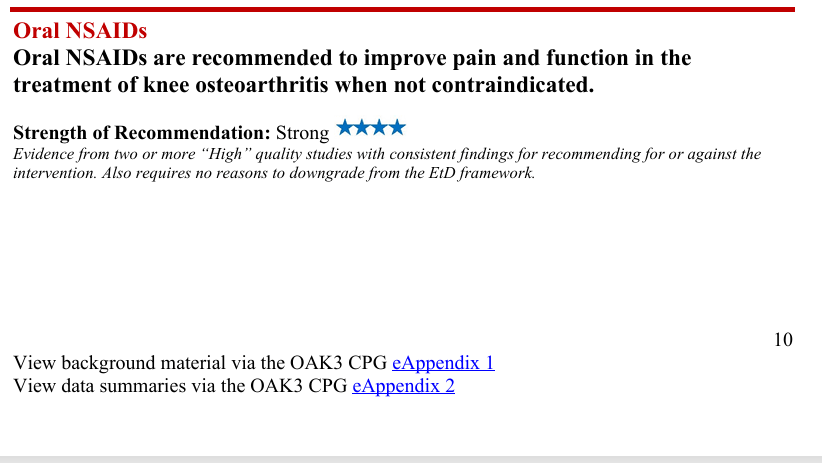
Nonsteroidal anti-inflammatory drugs (NSAIDs), such as ibuprofen or naproxen, can reduce both inflammation and pain. There are also prescription strength anti-inflammatories that can be prescribed by your physician. This is often the first step in management as arthritis is an inflammatory condition so these medications help reduce the symptoms associated with inflammation. However, these medications are not always appropriate for everyone and may have gastrointestinal, kidney, cardiovascular, or other risks.
Acetaminophen (or Tylenol) may be an option for certain patients, although its effectiveness for arthritis pain varies. Tylenol is typically safe for use in patients who may be unable to take anti-inflammatories.
Topical anti-inflammatory medications can also be useful, particularly for knee arthritis. A popular choice is Voltaren gel (Diclofenac gel) which can be prescribed or obtained over the counter at any pharmacy or drug store.
Before regularly taking any medication for arthritis, it is important to discuss it with your physician, especially if you have other medical conditions or take prescription medications.
&srotate=0)
Medications for Arthritis Symptoms
&srotate=0)
AAOS NSAID Recommendations
5. Cortisone Injections
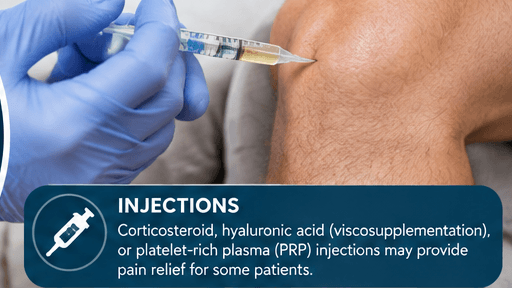
Corticosteroid, or “cortisone,” injections can provide temporary relief from arthritis pain and inflammation.
These injections do not reverse arthritis or regrow cartilage, and the duration of relief varies considerably from patient to patient. Some people experience significant improvement, while others receive little benefit.
Cortisone injections can be particularly useful when trying to control a temporary flare of arthritis or when a patient is not yet ready to consider surgery.
We discuss the AAOS recommendations around injections in another blog post.
&srotate=0)
Injections for Arthritis
6. Hyaluronic Acid Injections
Hyaluronic acid injections, sometimes called “gel injections,” are another treatment sometimes used for knee arthritis.
Results are variable. Some patients report improvement, while others experience little or no benefit. These injections are generally used for knee arthritis rather than hip arthritis.
Whether they are appropriate depends on the individual patient, the severity of the arthritis, prior treatments, and other factors.
7. What About PRP and Other “Regenerative” Injections?
Platelet-rich plasma (PRP) and other orthobiologic treatments have received significant attention.
Some studies suggest PRP may improve pain and function in selected patients with knee osteoarthritis, particularly those with mild to moderate disease. However, results vary depending on the patient and the preparation used.
It is also important to understand what these treatments have not been proven to do. Despite claims sometimes made in advertising, currently available injections have not been shown to reliably regrow normal cartilage or reverse advanced osteoarthritis.
Patients considering these treatments should have a clear discussion about the available evidence, expected benefits, limitations, risks, and costs.
8. Braces, Canes, and Other Assistive Devices
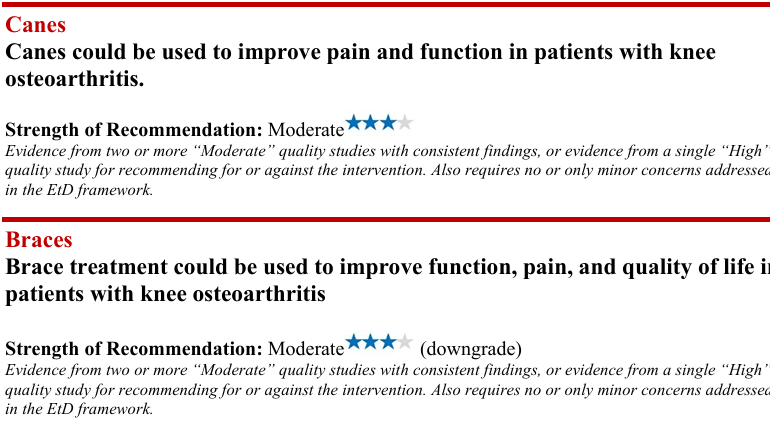
A knee brace may be helpful for certain patients, particularly when arthritis predominantly affects one side of the knee.
A cane or other walking aid can also decrease stress on a painful hip or knee. While patients sometimes resist using an assistive device, it can be a simple way to remain mobile and independent during periods of increased symptoms.
&srotate=0)
Bracing
&srotate=0)
Cane Use
&srotate=0)
AAOS Recommendations Canes and Braces
What Treatments Actually Reverse Arthritis?
This is one of the most common questions patients ask.
Unfortunately, we currently do not have a medication, injection, supplement, or exercise program that reliably restores a severely arthritic hip or knee to normal.
Non-surgical treatments are primarily designed to manage symptoms and maintain function. They can be very effective, but they do not eliminate the underlying structural changes associated with advanced osteoarthritis.
This distinction is important when evaluating treatments advertised as being able to “regrow cartilage” or “cure arthritis.”
How Do I Know When Non-Surgical Treatment Is No Longer Enough?
There is no universal point when someone must have a hip or knee replacement.
Joint replacement becomes a consideration when arthritis is significantly interfering with your quality of life and reasonable non-surgical treatments are no longer providing adequate relief.
Signs that it may be time to discuss surgical options include:
- Increasing difficulty walking or climbing stairs
- Pain that limits work, exercise, travel, or recreational activities
- Pain at rest or at night
- Progressive stiffness or loss of motion
- Increasing dependence on medications or injections
- Symptoms that continue despite appropriate non-surgical treatment
Even then, the decision to proceed with surgery is individualized.
Finding the Right Treatment for You
Treating hip and knee arthritis is not about simply looking at an X-ray and deciding whether someone needs surgery.
The goal is to understand how your arthritis is affecting your life and choose the least invasive treatment that allows you to remain active and do the things that matter to you.
For many patients, that means exercise, medications, activity modification, weight management, or injections. For others with advanced arthritis and persistent symptoms, hip or knee replacement may eventually provide the most reliable long-term improvement.
As a fellowship-trained hip and knee replacement surgeon in Jacksonville, Florida, my goal is to help patients understand the full range of treatment options—both surgical and non-surgical—and make an informed decision based on their individual needs.
If hip or knee pain is interfering with your daily activities, an orthopedic evaluation can help determine the cause of your symptoms and develop a treatment plan that is right for you.
Recent Posts
Injections for Hip and Knee Arthritis: What are the options?
Review of the recommendations and research on the 3 main injections that are typically offered for arthritis including steroids, gel, and PRP
Total Knee Replacement: How is it actually done?
This article describes in detail the specifics of how a knee replacement is performed.
Non-Surgical Treatment Options for Hip and Knee Arthritis
There are several non-surgical treatments that can help reduce pain, improve function, and allow you to remain active while avoiding surgery